threo.js > Cynthia and Her Drawings
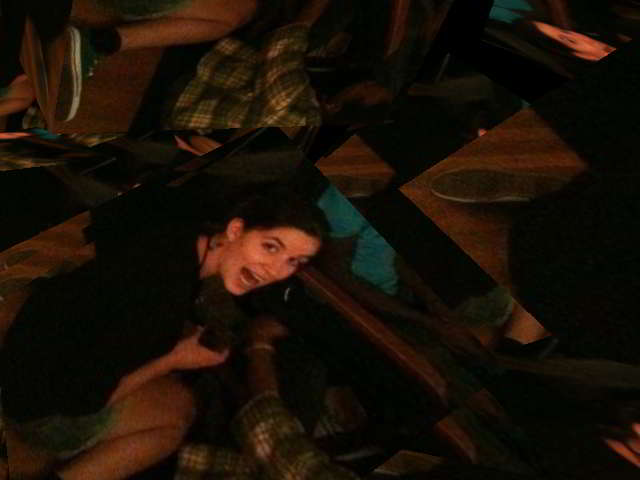
screen capture of Cynthia Herself demo.
Cynthia Herself
There's onnly a single photo of Cynthia here - but its reproduces 1,200 times. Overall there's a nice 'liveness' to the piece. Is that from the code or from the subject herself?
Trefoil by Cynthia
This was the first one I built and it may be my favorite. The courves in the drawing and tthe balance of light and dark break up the cubes nicely.
Ligtning bolt by Cynthia
In this one I deliberately cropped the image so that it was square and would have a white border. The light borders make the cubes stay in focus.
Lace-like Squiggles by Cynthia
In this demo, the drawing is cropped as a perhect square with no border. As the images swirl around it begins to be difficult to see where one cube ends and the next begins. It's a bit like looking at a pot of boiling granite pebbles.
Update
The code for each of the demo files has been cleaned up considerably. As is so often the case, when you revisit code written a few days previously, you often find many significant ways of reducing the amount of code and making it more effocient. And yet, at the time you were writing the original code, you were ever so pleased with its efficacy.
2011-02-02
Notes
These demos are built on top of three.js which is a lightweight 3D engine working over WebGL that is "with a very low level of abstraction (aka for dummies)". All I can say is "Works for me!"
The demos were created on top of the shortest, tightest "hello world" applet for three.js that I have been able to come up with so far. My guess/hope is that if they were minified that each would be less that 1,000 bytes - not including the three-js files or the texture images.
Because of their tightness these files do not contain a warning that you need a browser that supports WebGL. Currently Internet Explorer does not support WbGL. Best to use Google Chrome or the beta versions of FireFox 4 and Safari 10.6 .
You will need a fast, recently made computer with a good graphics card in order to view these demos. Before too long I will build version that will ask you for the amount of complexity to display before the demos begin.
One could say that these demos are somewhat "cubist" oriented. And that may be a fair comment. In 1906 Pablo Picasso tried to show that artists could do more and better than still cameras or even movie cameras. Perhaps in the animated processing of the 1,200 images (200 cubes with six faces each) in each demo there is a feeling of having more than enough cameras.
An interesting aspect of the demos is that each one has quite a different feeling to it. Yet technically all the demos run the same code and at the same speed.
Theo Armour, 2011-01-23